Announcements
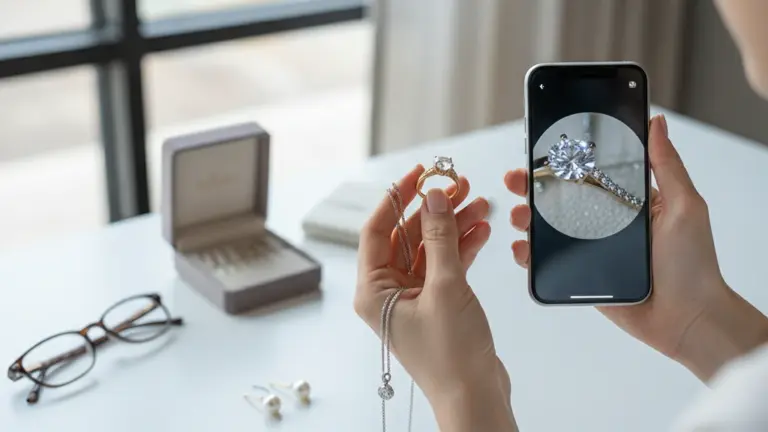
You have jewelry at home and you don't know if it is authentic. How to identify if that diamond is real or just an imitation glass? There are mobile applications that analyze precious stones and verify the authenticity of your jewelry in seconds.
Internal site links.
Announcements
Modern apps use artificial intelligence and gemological databases to inspect gold, silver, diamonds and gems. Without going to a professional jeweler, you can discover the real value of your pieces right from your phone.
This article shows you how these tools work, which ones to download for free, and what results to expect from each one.
 4.5
4.5
Bijou
Announcements
Information subject to alteration. Consult the official website for updated details.
How These Applications Work
The apps for identify jewelry they analyze images of your pieces using computer vision algorithms. The camera captures details such as brightness, refraction and crystalline structure of the stones.
Compared to a gemology database, these characteristics are paired with known patterns of authentic diamonds, rubies, emeralds and other minerals. The result appears in seconds with a percentage of confidence.
- Light analysis: detects how stone reflects and refracts natural light
- Color comparison: identify specific shades according to international scale
- Mineral structure: recognizes inclusions and unique characteristics of real gems
- Gemological database: compare finds with millions of certified stones
Some apps include approximate density meters and relative weight analysis if you upload manual data.
Free Apps to Test Joias
There are several options at no upfront cost on Google Play and the App Store. Most allow free download and perform basic tests without membership.
Bijou is a leader in this segment, specializing in jewelry authentication. Offers instant analysis of diamonds, colored gems and precious metals. Download the app and take a clear photo of your jewelry under natural light for immediate results.
Other popular applications include options that detect true gold by approximate spectral analysis. Although less accurate than certified laboratories, they offer reliable initial evaluation.
- Simple interface: you only need clear photography of the stone
- Results in seconds: don't expect long processing
- Saved history: compare analyzes of multiple jewelry on your profile
- Downloadable reports: export PDF results for future reference
- No mandatory registration: some work anonymously
Most of these apps offer a free version with limitations. You can test one or two jewels a day without paying. Premium subscriptions unlock unlimited analytics and detailed reports.
Identify Real vs Fake Diamonds
The authentic diamond it has unmistakable optical characteristics that a trained app can detect in photos. Glass, cubic zirconia and other simulants shine differently under natural light.
The applications analyze brightness (type of reflected light) and scattering (colored rainbows). Real diamonds show a specific pattern of refraction that fake ones do not replicate perfectly.
When you upload a photo, the algorithm looks for these characteristic optical signatures. If it detects inconsistencies, it warns you that the stone could be simulant.
- Refractive index: diamond = 2.42, glass = 1.52
- Uv fluorescence: diamonds respond differently under ultraviolet light
- Moiré and patterns: they are unique in real crystal structures
- Fire board: the refractive geometry is characteristic of diamond
However, these apps do not replace certifications from laboratories such as GIA or AGS. For high-value jewelry (more than 5,000 euros), always resort to professional certification.
Discover Valuable Gemstones
You own an inherited jewel and do not know its true nature. Is it synthetic or natural ruby? Does that emerald have inclusions that reduce its price?
The apps analyze these visual characteristics. They recognize gems such as rubies, sapphires, emeralds, amethysts and authentic topaz. They also detect common treatments (irradiation, heating, staining) that affect value.
When you discover precious stones what you have at home, the applications give you an estimate of rarity. A Colombian emerald is more valuable than a synthetic one, and the app communicates this clearly.
- Gem type: ruby, sapphire, emerald, amethyst, topaz automatically identified
- Approximate origin: some apps suggest geography of origin based on color and characteristics
- Detected treatments: warns about irradiation, heating or dyeing
- Color scale: compare with international classification standards
- Estimated clarity: analyze visible inclusions in photography
This information prepares you before taking the jewelry to a professional appraiser. You will know what questions to ask and if the appraiser offers you a fair price.
Check Precious Metals
True gold has specific density and conductivity. Although an app does not measure conductivity directly (that requires special hardware), it can analyze color, finish, and oxidation patterns in photographs.
The authentic gold it does not pale under direct light or show rapid discoloration. The applications compare the tone of your jewelry with profiles of pure gold (24K), 18K gold, 14K and simulants such as brass.
For silver, the app detects natural oxidation versus abnormal corrosion patterns. Oxidized sterling silver (925 or 950) has visual characteristics that the fallacies do not replicate.
- Gold tone: difference 24K, 18K, 14K, 10K automatically
- Surface finish: recognizes professional polishing versus false wear
- Oxidation patterns: analyze natural patinas in real silver
- Seal of authenticity: read engraved marks if they are visible in clear photo
Some fake precious metals shine too bright or have a plastic finish. Trained apps may notice these subtleties. For definitive verification, they require chemical confirmation in the laboratory.
Real Cases of Use
A collector inherits 12 rings from her grandmother. Ignore which one has real diamond and which one is glass. Download the app, take clear photos under natural light of each ring and get results in 20 minutes. Three results indicate authentic diamonds; the others are simulants.
An online seller buys second-hand jewelry. Use the app to authenticate jewelry before listing in your store. If you detect inconsistencies, reject the purchase. This practice reduces returns from dissatisfied customers.
A professional jeweler complements your visual appraisal with app analysis. Although it does not replace its expertise, it provides quick confirmation of gemological characteristics. It is especially useful for colored gems that are difficult to distinguish with the naked eye.
An online buyer receives a certified sordiamante from an unknown seller. Before paying, take a photo with the app. The results suggest cubic zirconia. Avoid fraud by requesting a refund before confirming the transaction.
Limitations and When to Turn to Experts
Although apps use advanced artificial intelligence, they make mistakes. Very small diamonds or diamonds with characteristic inclusions can be confused with simulants in low resolution photos.
The photography quality it's critical. Poor light, reflections, shadows or unfavorable angles reduce accuracy significantly. If the app fails to clearly identify, it resumes the photo in better lighting.
- Jewelry with a value greater than 3,000 euros: they require a professional laboratory certificate
- Uncertified diamonds: requires formal gemmological appraisal before sale
- Very small stones: difficult to analyze by app, they require an expert magnifying glass
- Gems with special treatments: only laboratory with spectral equipment confirms
Apps are initial assessment tools, not substitutes for professional certification. For family-owned jewelry or expensive purchases, always consult a certified gemologist.
See also:
- Learn to drive right now using your mobile phone
- DETRAN simulated apps and driving school questions
- Free DETRAN simulator on mobile: recommended apps
- Driving school simulator apps: free download and practice
- Create your music right now right from your phone with AI
Trends in Gemological Technology
Artificial intelligence in gemology is growing rapidly. International laboratories train models with millions of certified diamond and gem images. Every year, precision improves significantly.
Augmented reality is being integrated into new versions. Point your camera at the jewel and see information superimposed: estimated value, probable origin, possible treatments. This makes the experience more interactive.
Some developers incorporate blockchain to save history stone identification precious. If you sell a piece of jewelry after years, the above analysis is still available as proof of authenticity.
Applications to detect gold by spectroscopy are also advancing. Although they require special hardware attached to the mobile, they promise more reliable analysis than just photography. These hybridized tools will be a trend in 2025.