Announcements
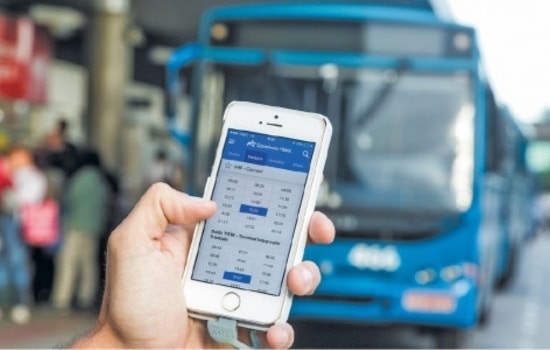
Missing the bus is frustrating and consumes your valuable time. Wouldn't it be ideal to know exactly when the next one arrives at your stop? Discover how modern apps allow you to track buses in real time from your phone.
Internal site links.
Announcements
Internal site links.
Urban mobility has completely changed in recent years. What previously required checking printed schedules or calling an information number now fits in your pocket. With a simple download, you have access to your city's entire public transportation network at your fingertips.
Announcements
We mention CittaMobi because it is a comprehensive solution that works in multiple Brazilian and Latin American cities. Simple access, reliable data updated every minute. Let's see why these apps transformed the way we move around the city.
 4.6
4.6
Cittamobi: Ônibus e Trilhos
Information subject to alteration. Consult the official website for updated details.
Why You Need a Bus App
Public transportation is the backbone of any modern city. However, the experience is frustrating without reliable information. Waiting indefinitely at a stop, not knowing if the bus is late, missing connections due to being late: these problems disappear with one onibus app in real time.
Urban transportation applications offer something that was previously impossible: precision. You don't trust theoretical schedules in a printed brochure. You see where is the bus now, how many minutes are left, and if you have known delays.
- Time savings: you wait only if there is reason, not uncertainty
- Exact planning: calculate your trip with minute precision
- Line information: access all routes from a single app
- Stop alerts: receive notifications when your bus approaches
- Travel history: review your previous journeys for useful patterns
How These Applications Work
The technology behind it is surprisingly simple but powerful. Apps receive live GPS data from every bus in the city. This constant stream of information is processed on servers and delivered to your updated phone every 10-30 seconds.
When you open the app, you see an interactive map. Your location appears as a point. Around, other points represent buses circulating. Tap any line to see its full route, stops, estimated times and current status.
The interface of track onibus in real time allows you to filter by line, destination or stop. Some apps include alerts: set up your usual stop and receive notification when the bus is 3 minutes away. So never surprises.
Differences Between Free and Paid Apps
The good news: most of the best solutions free onibus app they offer full functionality without paying a cent. Why do some charge then?
- Basic free apps: schedules, real-time location, route maps
- Premium apps: no advertising, custom alerts, expanded history, partial offline mode
- Advertising: free versions usually have banners, but they do not interfere with core functions
- Unlimited data: unlimited queries on all mentioned versions
For most users, the free version is sufficient. Only consider paying if you use the app daily for multiple trips and want an experience without advertising interruptions.
The Best Features You Should Look For
Not all public transportation applications they are the same. Some offer features that significantly highlight them. Identify which ones matter for your daily routine.
The search by bus stop it's essential. Write the name of your stop or area, and the app lists all the buses that pass in the next few hours. Some apps go further: they suggest combined routes (bus + metro) to reach specific destinations.
Push notifications are transformative. Set up your favorite stops and the app alerts you when there are minutes left before the bus arrives. Some users activate alerts 15 minutes before their usual departure time, guaranteeing never to be late.
- Interactive map: view the entire urban transportation network on a map
- Custom favorites: save routes and stops that you use frequently
- Travel history: check where you have traveled and when to plan better
- Integration with other transport: combine bus, subway, bike sharing in a single app
- Accessibility: information on stops adapted for people with reduced mobility
- Dark mode: reduces visual fatigue on night trips
Real Cases of Use
Imagine that you work in the city center but live 20 kilometers away. Before these apps, your routine was unpredictable. You left an hour early, you waited without knowing if the bus would arrive on time, you arrived at work inconsistently.
With one onibus tracking app, your morning changes completely. You open the phone at 7:15, you see that your usual line arrives at 7:28. You set an alert for 7:25. At that time, you receive the notification, you prepare for the last minutes, you leave exactly when you need to. You arrive at the stop just as the bus does.
Another scenario: it's Friday night and you left an appointment later than expected. You want to take a bus but you have no idea what lines run at that time. You open the app, write your location and destination, see three options with estimated arrival time and transfers. In 60 seconds you planned your return home.
Students also benefit greatly. Many have variable schedules depending on their academic calendar. An application of onibus in real time allows for quick adjustment: If a class ended 30 minutes earlier than expected, immediately check when the next bus is coming instead of waiting for the time you wrote down.
Cities with Better Coverage
Not all cities have the same data quality. Brazilian metropolises such as São Paulo, Rio de Janeiro, Brasília and Belo Horizonte have almost complete coverage. However, smaller cities vary considerably.
Before downloading an app, check if your city is included. Most major platforms have a coverage page or geographic filter. If your location is missing, the app simply won't work, so it's important to confirm first.
Latin American cities such as Medellín, Bogotá, Mexico City and Lima also have growing options. The development of these solutions is increasingly rapid, and new cities are constantly integrated through alliances with local governments.
Initial Configuration in Five Steps
Downloading is just the beginning. Optimize your app in minutes for maximum benefit and never miss your city bus again.
First, open the app and enter your location. Most request location permissions. Grant them for real-time tracking to work. Without this permission, accuracy decreases significantly.
Second, look for your usual stop. Write the name or select on the map. The app will show you all the lines that pass through there. Identify which one you normally use.
Third, bookmark that stop. This speeds up future queries. The next time you open the app, your favorite stop appears instantly without a search.
Fourth, enable notifications. Go to settings, look for alerts or notifications, and customize how many minutes before you want to receive a notification. We recommend 5-10 minutes before your usual departure time.
Fifth, explore additional options: history, alternate routes, integration with other transports. Each app is slightly different, but the basic principles are identical.
Quick Comparison of Popular Apps
The market offers several competing options, each with different strengths. Let's compare the key characteristics that differentiate the main players.
CittaMobi stands out for its extensive coverage in Brazil and neighboring countries. Its interface is intuitive even for inexperienced users. The data is constantly updated thanks to alliances with transport operators. It works on both Android and iOS identically.
Other platforms offer different emphases: some prioritize beautiful visual maps, others emphasize search speed. Some include integration with shared mobility apps. Experiment with two or three to find which one best aligns with your daily workflow.
- Geographic coverage: check that your city is included before deciding
- Data updates: prefer apps updated every 10-30 seconds, not every minute
- Interface design: choose according to your preference: large maps vs. line lists
- User support: apps with chat or FAQ respond better in emergencies
Future Trends in Urban Mobility
The sector of urban transport evolves rapidly. Artificial intelligence, demand prediction, multimodal integration are trends that will transform the next generations of applications.
We already see apps that predict delays before they occur using historical patterns. If it rained the last 5 Thursdays at 7 PM and the bus arrived 15 minutes late, the next Thursday rain at that time will show a probable delay alert.
Complete mobility integration is inevitable. A single app will handle your entire trip: leave your house on foot, switch to bus afterwards, end on a shared bike. All planned and tracked within a single platform. Some users already experience this in leading cities like São Paulo.
Integrated payments are another development. Some cities allow you to purchase tickets directly from the app, eliminating the need for physical transportation cards. The QR code generated on the phone is your ticket.
Finally, open data and transparency are priorities. Cities are pushing for all transportation companies to share data in real time. This creates a more robust ecosystem where multiple apps can compete using the same quality information.