Announcements
Learning to play the violin has never been as accessible as it is today. The educational applications they revolutionized the way people acquire new musical skills, allowing anyone to start from scratch using just their phone. This article will show you how modern apps transformed music education and why learning fast violin is completely possible with the right tools.
Internal site links.
Announcements
Internal site links.
Why Learning Rapid Violon is Possible with Mobile Apps
For decades, learning to play an instrument required expensive in-person classes, fixed schedules, and specialized teachers. Today, technology has completely changed this landscape. Music apps allow anyone, regardless of age or geographic location, to access structured lessons from the comfort of their home.
Announcements
The main reason behind the success of these apps is the adaptive methodology. These programs analyze your progress in real time and adjust the difficulty level automatically. If you quickly master the basic chords, the app speeds up your progress. If you need more practice in specific techniques, provide additional exercises without penalizing yourself.
Recent statistics show that people who use music learning apps achieve measurable results in just three weeks of consistent practice. The key is consistency, not hours spent. Studies show that 15 minutes a day produces better results than occasional two-hour sessions.
Main Characteristics that Make a Difference in Learning to Read Music
One of the main obstacles when learning the violin is understanding musical language. Reading sheet music intimidates many beginners, but the best apps solve this problem with intuitive interfaces and progressive exercises.
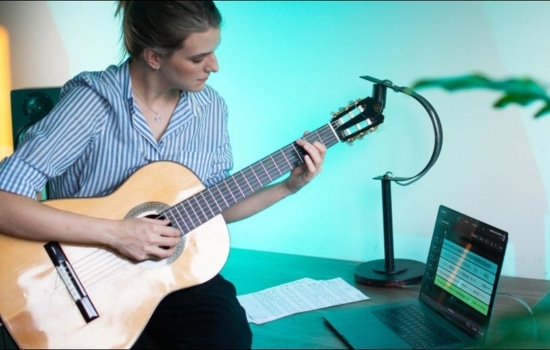
Modern educational apps include visual recognition tools that show exactly where to place your fingers on the fretboard. While studying the score, the app projects colored dots on your screen indicating the correct position. This visual learning technique accelerates mastery of music reading compared to traditional methods.
Additionally, most of these apps allow you to record your progress. You can play recordings to hear exactly where you made mistakes, identify rhythm problems, and consistently improve. This immediate feedback is crucial to learning to read music without frustration.
Another fundamental aspect is gamification. Educational application developers incorporate scoring, achievement and challenge systems that keep motivation high. When they achieve goals, users receive virtual badges and unlock new lessons, generating a sense of constant progress.
The Importance of Easy Reading in Music Education
When we talk about easy reading in a musical context, we are referring to user interfaces that do not saturate the student with unnecessary information. A good app for learning fast violin presents only what you need at each specific moment of your learning.
Many traditional educational applications make the mistake of displaying all music theory simultaneously. A well-designed app, on the other hand, introduces concepts gradually. First you learn the basic notes, then simple chords, then rhythms, and finally advanced strumming techniques.
Typography also plays a crucial role. The best apps use clear fonts and adjustable font sizes specifically optimized for mobile screens. This is essential considering that you will probably learn while holding the violin with one hand and consult the app with the other.
Plus, intuitive navigation lets you switch between sections without confusion. If you need to review a previous concept, the app takes you there with a single tap. This accessibility reduces the learning curve significantly.
Musical Writing Applications: Beyond Just Reading
Learning to play the violin involves not only reading music, but also understanding how to write it. Many educational apps offer composition tools that allow users to create their own scores as they progress in their learning.
These writing apps work like smart digital bookcases. You write or draw notes on the screen and the app recognizes what you are trying to create, playing the sound automatically. This feature is invaluable because it transforms the process of writing music into something fun and interactive.
The ability to write music also reinforces your understanding of the theory. When you create a chord progression from scratch, you unconsciously assimilate how harmonic relationships work. Students who use these writing features in educational apps report better knowledge retention.
Some applications allow you to collaborate with other musicians. You write your violin section, other users contribute guitar or drum parts, and together they create complete songs. This community functionality transforms learning into a motivating social experience.
Music Literacy: The Foundation for Learning Fast
Music literacy is the equivalent of learning to read and write in traditional education. Without mastering this fundamental aspect, progressing quickly on the violin is practically impossible. The best apps recognize this and dedicate significant resources to developing this skill.
A typical app music literacy program begins with identifying individual notes. You see a note on the staff and you must recognize it correctly. The app measures your response speed and adjusts the difficulty when you reach an accuracy threshold.
Then you move towards rhythmic patterns. The app plays sequences of notes and you must identify the exact rhythm. This listening practice develops your musical ear simultaneously with your reading ability, exponentially accelerating your learning.
Music literacy also includes understanding scales, intervals, and chords. A well-structured educational app presents these concepts as connected to each other, not as isolated themes. You understand that a scale is a series of specific intervals, that chords are combinations of notes from those scales, creating a coherent system in your mind.
Learning with Fun: Gamification in Music Applications
The fun factor is as important as the quality of the educational content. An app can teach you perfectly, but if you don't enjoy the process, you will quickly abandon it. For this reason, the best educational applications for violons integrate game elements that keep your motivation high.
Gamification works because it activates the brain's reward systems. When you complete a lesson, you receive points. You accumulate points to unlock new songs. You compete with friends on scoreboards. All of these mechanics generate dopamine, the neurotransmitter associated with motivation and satisfaction.
Some apps include weekly challenges where competitions against users from all over the world. You play a specific song during the week, the app measures your accuracy and speed, and places you in a global ranking. This friendly competition keeps the learning process exciting and challenging.
Other music apps offer narrative progressions. Instead of simply practicing exercises, you complete missions in a story that unfolds as you progress. For example, your character is a traveling musician who must complete musical challenges in different cities to progress the plot.
Optimization of Applications for Mobile Screens: Learn at Any Time
The biggest benefit of using apps to learn the violin is flexibility. While traditional classes require you to set aside specific time, educational apps work according to your personal schedule. You study during lunch break, in transportation, or before bed.
The best apps are completely optimized for smartphones. This means responsive interfaces that automatically adapt to different screen sizes. A score doesn't look the same on a 5-inch phone as it does on a 10-inch tablet, and quality apps adjust the layout to maximize readability on each device.
Optimization also includes battery efficiency and data consumption. A well-designed app does not quickly drain the battery or require a constant internet connection. Many allow you to download lessons for offline practice, essential for those with limited access to mobile data.
Additionally, the best apps sync your progress between devices. You practice on your phone during the day, then continue on your tablet without losing data. This cloud sync ensures that you never lose track of your progress.
Free Downloads versus Premium Versions: Maximize your Budget
A common question is whether you really need to pay for apps to learn fast violin. The answer is nuanced. There are excellent apps that are completely free, but many offer premium versions with additional features.
Free versions generally include enough content to reach an intermediate level. You access fundamental lessons, basic music reading exercises, and a community of users. It is entirely possible to learn the fundamentals without spending money.
Premium versions typically offer unlimited content, professional songs produced specifically for the app, detailed analysis of your progress, and priority support. If you have resources available and want to speed up your learning, the premium version is worth it.
A smart strategy is to start with the free version to evaluate if the app suits your learning style. Once confirmed, then consider the premium version. Many apps offer free trial periods for premium features, allowing you to fully experiment before committing financially.
Connecting Theory and Practice: Educational Application Exercises
Music theory without practice is useless. The best apps recognize this and perfectly balance conceptual teaching with extensive practical exercises. Each musical reading or writing lesson is accompanied by dozens of reinforcing exercises.
Exercises in educational apps vary in format. Some ask you to identify notes in a score. Others require you to play the exact notes that the app plays. Some feature snippets of popular songs and ask you to identify chords. This variety prevents boredom and develops multiple aspects of your skill.
The most important thing is immediate feedback. You complete an exercise and instantly see if you were right or wrong. If you failed, the app explains exactly what went wrong. This immediate response is crucial to correcting bad habits before they solidify.
The intelligent algorithms within these applications also generate personalized exercises based on your weaknesses. If you constantly confuse the notes on the third line of the staff, the app will create more exercises focused precisely on that area.
Communities Within Applications: Collaborative Learning
Learning musically doesn't have to be a solitary activity. Many educational applications include vibrant communities of users where they can share experiences, get feedback, and motivate each other.
These communities function as musical social networks. You record your progress by playing a song, upload it to the app, and other users can listen to it and comment constructively. Receiving feedback from people at your same level of learning is invaluable in identifying areas for improvement.
Some apps also make virtual group classes easier. An instructor leads multiple students through a live lesson, allowing for real-time questions and demonstrations. This hybrid modality combines the flexibility of autonomous learning with the benefit of personalized instruction.
Friendly competition within these communities also motivates. You see the progress of other users similar to you, which inspires you to try harder. Celebrating joint achievements creates a sense of belonging critical to long-term persistence.
Tracking Progress: Metrics That Matter in Your Music Education
One of the unique benefits of learning through apps is the ability to precisely track your progress using data. While in traditional classes you relied on the teacher's subjective evaluation, apps provide objective metrics of your improvement.
The best educational apps automatically record your exercise accuracy, music reading speed, average time to identify notes, and overall consistency. This data is presented in clear graphs showing your temporal evolution.
Visualizing your progress is psychologically powerful. Seeing your accuracy improve from 70% to 92% in chord identification in three weeks provides concrete motivation to continue. Data transforms learning from a vague experience into a measurable and achievable process.